
 It’s challenging enough to express yourself across one medium, much less two. Andrew Dickson, a Portland, Oregon-based artist, father, and polymath, however, has developed outlets of personal expression across multiple disciplines, including performance art, writing, auctioneering, storytelling, professional advertising services, filmmaking, life coaching, acting, voice-overs, and teaching. His multifaceted body of work is subtly subversive, with unexpected utility and a life-affirming narrative core. In life and in art, Andrew wants you to practice hard and show your work so you can succeed and do interesting things.
 And that’s not all. Andrew has a day job as copywriter for the renowned advertising agency Wieden + Kennedy too, where he recently shepherded the successful Seven Wonders of Oregon campaign for Travel Oregon (and where he’s also been a key part of campaigns for brands such as Old Spice and Starbucks). Part of his impressive range might come from his family, where his father, Paul Dickson, is the author of more than 45 nonfiction books and hundreds of articles, including the popular Dickson’s Baseball Dictionary, but it’s also pragmatic. As Andrew says, an integral part of being a creative or freelancer today means “you have to have irons in the fire.”
 For Andrew, execution is built on a foundation of consistent practice, whenever and wherever he can find it. “My process is the same, whether it’s giving a speech or doing a show: if it’s something really long, I will write it. But to develop it, I rehearse it. In the basement, on the walk home from work — and people will think you’re crazy and won’t talk to you — the car’s good, too.”
“For a ten minute piece, I’ll probably rehearse it ten times. And by the end of it, I got it. But my trick is that it’s always 80% memorized and 20% improvised, so that it allows you to mine if you find something people are connecting with or laughing with, and you’re getting reaction, you can add another bit or two, you can improvise in the moment, which is where the really interesting stuff happens. And if it’s not 100% memorized, then if you forget something, you’re free. It doesn’t trip you up.”
Rehearsal means really taking hold of a concept, engaging with it, and allowing the work to emerge. “That process of rehearsing is how you hone it, and get the jokes, and get the timing. It’s all about transitions. You’ve got eight points to make. How do you tie them together?” Strong transitions help make a piece “feel like a narrative, not a list of bullet points.”
After rehearsal is done, it’s time for the work to evolve publicly. “No matter how many times you rehearse it, once you do it in front of an audience, then you understand where it lags, the jokes that people didn’t think were funny...sometimes the things you think were going to kill, don’t.”
And that can work, too, with a bit of savvy expectation setting. Although his performances are often hilarious, Andrew says he’ll “never do stand-up comedy because people expect you to be funny. So I do everything else and I make it funny, so that [people say] “And I laughed!” It’s a bonus. I like to make you think it’s something else, so then when you do laugh, you say ‘It was funny too!’ And if you don’t get the laughs, people will say ‘Yeah, it was really interesting’ and so you’re not just up there bombing with jokes that aren’t working.”
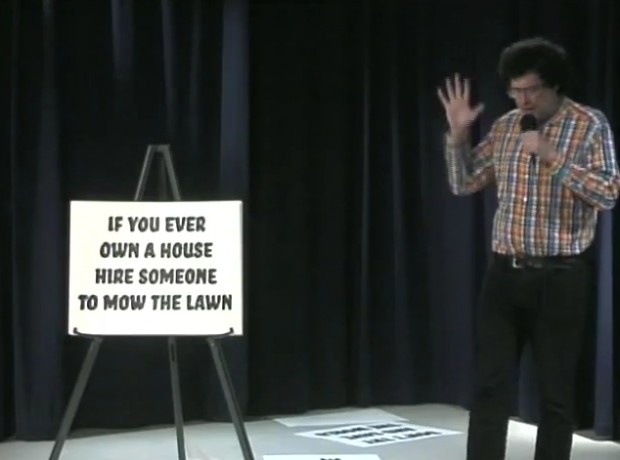 Andrew encourages other creatives to place a high value on communication skills and embrace public speaking. “I think getting up in front of people is important no matter what you do. Even if the idea is genius, you still have to make the argument and make it in front of a room full of people. You have to present it in a way where it comes alive.”
Public speaking is a huge part of an artist’s job. “For artists...you’re either going to teach or, until you get to the [next] level, you’ll be doing artist’s lectures. You’re going to be going to colleges and speaking in a gallery or invited into collectors’ homes or having dinner where you’ll be invited and expected to talk about your work. If you’re a designer, you can make a great logo, but until you can articulate that what their brand stands for is somehow encapsulated in this mark, it just is a mark. Anyone who is in any creative field, to be able to get up in front of a group of people and explain something and really connect with people, I think that’s a big thing.”
“You just have to do it and keep doing it.”
And when Andrew gets up and does it, it’s invigorating. “When I go onstage and present, it’s me. I can do whatever I want. It’s full-on personal expression.”