
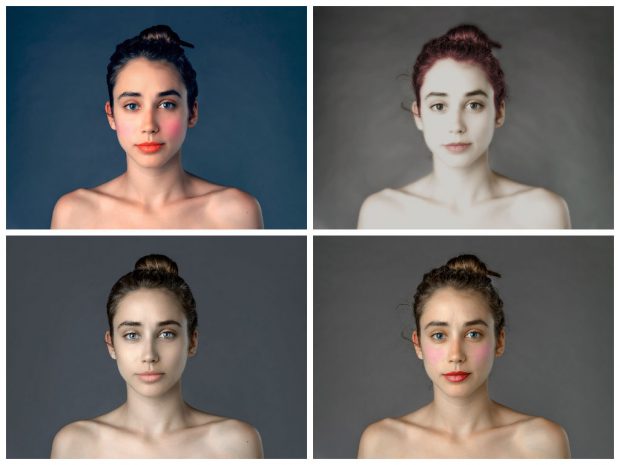
 Photos courtesy Esther Honig.[/caption]
Sometime around Thursday, June 26, you probably saw Esther Honig’s face. You saw her face as it was, but more importantly, as it could be, if it represented various standards of beauty according to Photoshop artists around the world. Yes, Esther is that girl suddenly everywhere in your Facebook newsfeed.
On that fateful day, Esther was humming along, eking out a living as social media manager, assembling radio projects on the side, and publishing her blog, when she got the notification that BuzzFeed had published her project. Within a half hour, she was fielding phone calls from major media outlets and seeing her name printed in international news reports.
Esther’s quietly incubated side project — in which she took a photo of herself, contacted retouchers around the world, and asked them to edit it with Photoshop to express their culture’s “standard or beauty,” clearly hit a nerve. Suddenly, everybody was talking about it. By Friday, Esther’s Photoshopped likeness could be found on websites belonging to Elle, Cosmopolitan, E! News, Time, HelloGiggles (a favorite of Esther’s), DesignBoom, and many more.
“I had it on my website for a very long time and I was hush-hush about it. My experience in media told me that if I took it to the right outlet first it might do better.” BuzzFeed, with its image-heavy lists, proved to be the right call.
“I took it to a reporter who had done previous stories about the implications of Photoshop and I told him this would be relevant to his interests and he passed it on to someone else and from there it was officially published in BuzzFeed Styles and then it just took off from there.”
To be clear -- Esther is not a photographer or a retoucher. This isn’t her usual thing. She took on this project because she was curious about the cultural implications. She’d been tracking the conversation on the prevalence of Photoshopped images and wondered what it might tell us about standards of beauty internationally.
“I went in with my observations as a consumer of media. Photoshop is a symbol of unattainable beauty in the US. We see bodies that are reshaped and faces that are made symmetrical. When we see something in print we know those image were digitally enhanced. Its an accepted part of our image landscape,” Esther explains.
“I thought [we in the U.S.] probably Photoshop people in a specific way. That is what I went out to discover.”
The retouchers she contracted delivered, returning a diverse array of images, with no single thread she could weave through them, and no geographical boundary explained the differences. Probably because, she says, there is no such thing as a standard retoucher.
“I thought there would be a clear line we would be to be able to draw and that we’d see this is evidence that this is something one culture finds attractive, but I still don’t know if that’s true. I came to the understanding that its not just a product of cultural influence but its also of that individual’s creativity and skill level.”
Yet that incongruent expression of taste and talent (or, as critics have pointed out, a lack thereof) captivated audiences around the globe. But, says Esther, it’s not because of her skill or her ability.
“I was literally just the publisher, the person who had the idea and brought it together. It wasn’t the best example of my journalist skill or my writing ability, it was an idea that I had, that I executed…The Photoshoppers were the designers and the photographer was the photographer, and I was somewhere in the middle.”
Now, Esther is in the middle of media onslaught. She took a hiatus from her job, put her boyfriend to work fielding her emails, and is excitedly awaiting her project’s appearance on NPR. She’s talked to The Today Show and Good Morning America and went from 40 Twitter followers to 2,600 in a weekend.
A project she’d hoped would maybe get her a single byline in a major publication to buoy her resume has made her Internet famous -- and now, Esther says, she needs to figure out what do with it.
“It was a terrifying three days,” she explained, though now that she’s getting a hold of things, it’s become more exciting. She’s currently busying herself by sending out thank-yous and corrections to journalists and digesting the new opportunities that might come with it.
“I’m still trying to figure out if this moment means it's time to move away from my day job, or is this a ‘don’t quit your day job’ thing.”
For now you can check out Esther and lots of her previous side projects that didn’t go viral on her website.