
 Photo via Tomos on Flickr.
When Alex Blumberg started his new podcast, StartUp, his goal was to tell the business origin story you never hear, "before the facts can fade into the 'this is the garage where it all started' mythology." That's a pretty accurate summation of a lot of brand stories --in fact, the story of "started in a garage" is such a Silicon Valley staple now, it's practically a necessary element to any new business's pitch. And while the idea of a million-dollar corporation having humble roots can help provide a roadmap, there are plenty of inspiration brand stories that break outside of that simple trope — and really do make great stories.
Photo via Tomos on Flickr.
When Alex Blumberg started his new podcast, StartUp, his goal was to tell the business origin story you never hear, "before the facts can fade into the 'this is the garage where it all started' mythology." That's a pretty accurate summation of a lot of brand stories --in fact, the story of "started in a garage" is such a Silicon Valley staple now, it's practically a necessary element to any new business's pitch. And while the idea of a million-dollar corporation having humble roots can help provide a roadmap, there are plenty of inspiration brand stories that break outside of that simple trope — and really do make great stories.
MailChimp — which is now used by millions to connect with their audiences via email — "began as a sideproject" by its founders, Dan Kurzius, Mark Armstrong, and Ben Chestnut.
 Demand is often a popular part of the narrative of small businesses — and usually, it's coupled with a lack of supply. The world's youngest self-made female billionaire, Sara Blakely, has made her living providing a product that she couldn't find anywhere. So, she made it herself.
"Working as a sales trainer by day and performing stand-up comedy at night, I didn't know the first thing about the pantyhose industry (except I dreaded wearing most pantyhose). Also, I had never taken a business class which made the process even more challenging. As a result, I had only one source to operate from...my gut," writes Sara on the SPANX website.
"I read several books on trademarks and patents and researched pantyhose patents at the Georgia Tech Library for weeks at night after work. I then approached several lawyers who thought my idea was so crazy that they later admitted thinking I had been sent by Candid Camera. To keep costs down, I wrote the patent myself and later found a lawyer who helped write the claims. My patent was approved and I successfully trademarked the name SPANX online! The original product drawing for the SPANX patent was sketched by my mom, an artist. (I was the model!)."
Sara also tracked out a manufacturer herself, and came up with most of the promotional material. The company — which is now worth billions — was grown almost entirely with her hard work.
Demand is often a popular part of the narrative of small businesses — and usually, it's coupled with a lack of supply. The world's youngest self-made female billionaire, Sara Blakely, has made her living providing a product that she couldn't find anywhere. So, she made it herself.
"Working as a sales trainer by day and performing stand-up comedy at night, I didn't know the first thing about the pantyhose industry (except I dreaded wearing most pantyhose). Also, I had never taken a business class which made the process even more challenging. As a result, I had only one source to operate from...my gut," writes Sara on the SPANX website.
"I read several books on trademarks and patents and researched pantyhose patents at the Georgia Tech Library for weeks at night after work. I then approached several lawyers who thought my idea was so crazy that they later admitted thinking I had been sent by Candid Camera. To keep costs down, I wrote the patent myself and later found a lawyer who helped write the claims. My patent was approved and I successfully trademarked the name SPANX online! The original product drawing for the SPANX patent was sketched by my mom, an artist. (I was the model!)."
Sara also tracked out a manufacturer herself, and came up with most of the promotional material. The company — which is now worth billions — was grown almost entirely with her hard work.
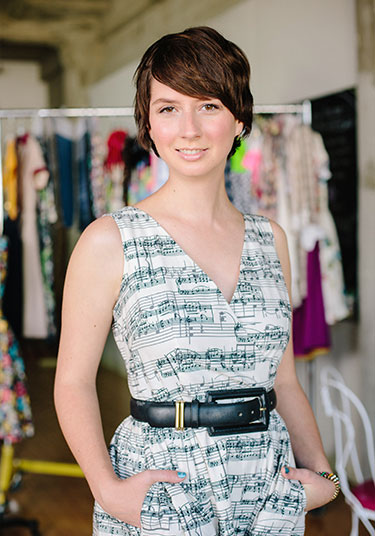 Sometimes, businesses come from a place of passion, as is the case with ModCloth. ModCloth co-founders, husband-and-wife team Susan Gregg Kroger (pictured, right) and Eric Kroger — created the retail website mostly because Susan loved vintage and thrifted dresses so much.
"ModCloth started as an outlet for Susan's love of fashion," according to the company website. "In high school, Susan spent most of her weekends and summers thrift store shopping. She often found herself unable to pass up a great vintage find, no matter the size.Soon enough, her closet was overflowing with vintage styles she loved, but couldn't wear. Eric – her then-boyfriend – designed a website to help her turn her thrifting into a more lucrative hobby. In 2006, after both graduated from Carnegie Mellon University, Susan and Eric decided to take ModCloth from a hobby to a career. They expanded their selection to include unique styles from independent designers from around the world."
Whatever the reason for starting your business, remember the details of the beginnings — write them down to ensure you don't forget. These small pieces (the late nights in the library, the way you started the website, what happened next) become your brand story. That way, when you're trying to explain to people why you do what you do, you not only have a clear focus, you also have a great tale to tell.
Photo: ModCloth founder Susan Gregg Kroger, via ModCloth.
Sometimes, businesses come from a place of passion, as is the case with ModCloth. ModCloth co-founders, husband-and-wife team Susan Gregg Kroger (pictured, right) and Eric Kroger — created the retail website mostly because Susan loved vintage and thrifted dresses so much.
"ModCloth started as an outlet for Susan's love of fashion," according to the company website. "In high school, Susan spent most of her weekends and summers thrift store shopping. She often found herself unable to pass up a great vintage find, no matter the size.Soon enough, her closet was overflowing with vintage styles she loved, but couldn't wear. Eric – her then-boyfriend – designed a website to help her turn her thrifting into a more lucrative hobby. In 2006, after both graduated from Carnegie Mellon University, Susan and Eric decided to take ModCloth from a hobby to a career. They expanded their selection to include unique styles from independent designers from around the world."
Whatever the reason for starting your business, remember the details of the beginnings — write them down to ensure you don't forget. These small pieces (the late nights in the library, the way you started the website, what happened next) become your brand story. That way, when you're trying to explain to people why you do what you do, you not only have a clear focus, you also have a great tale to tell.
Photo: ModCloth founder Susan Gregg Kroger, via ModCloth.