In 2011, I spent 6 months trying to have a “real job” at a law office, 2 months cooking in a Michelin-starred kitchen in Ireland, 1 month traveling around Europe, and 3 months starting my graduate degree in English and managing student art shows.
It didn’t really translate to my resume. I seemed like a distracted cat jumping between balls of yarn and those tiny mice with bells in the middle.
And these days it’s not that much easier to put my work on paper. While I do have a full-time, resume-friendly job, I also blog outside of work, own a restaurant with my husband, and build the occasional website.
If you’re like many creatives, this is probably a familiar story. Maybe you
hop from exciting project to interesting collaboration every few weeks or months. Or maybe you have a full-time job, but you also do TONS of creative work when you’re not at the office.
All that creative energy leaves you with a unique set of worries when it comes to resumes. Worries like:
How do I share my story without seeming unfocused?
Which projects should I actually include on my resume?
How do I talk about
my side project that has nothing to do with my day job?
Or even:
How do I make this all fit on one page?!
And most importantly:
How do I make people want to hire me??
I put together 12 resume tips that'll help you take that exciting, fulfilling jumble of
creative work and turn it into a resume that can actually get you hired.
[Tweet ""Check out these 12 essential resume tips for creatives." @randlebrowning"]
And if you want a simple guide that outlines all the tips here and more, don’t forget to download
The Ultimate Guide to the Perfect Resume here! You’ll also find out how to update your resume in just 15 minutes.
1. Keep it minimalist
Fashion bloggers aren’t the only ones looking to cut the fluff. Rather than including your entire work history, limit yourself to your top 4 most relevant (and likely, recent) work experiences.
Surrounding your credentials with white space rather than crushing in every detail imaginable will draw the hiring manager or future client’s eye to the most relevant parts of your history.
[Tweet ""Leave room for white space on your resume and it'll draw more attention." @randlebrowning"]
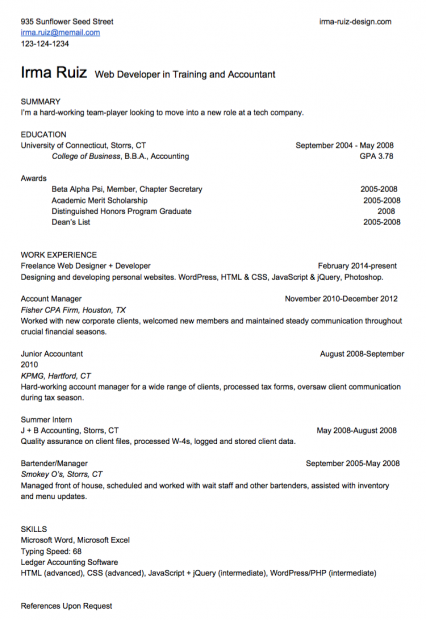
For example, check out this overcrowded resume. Can you even tell what kind of job Irma wants?
Now look at a pared down version of her resume.
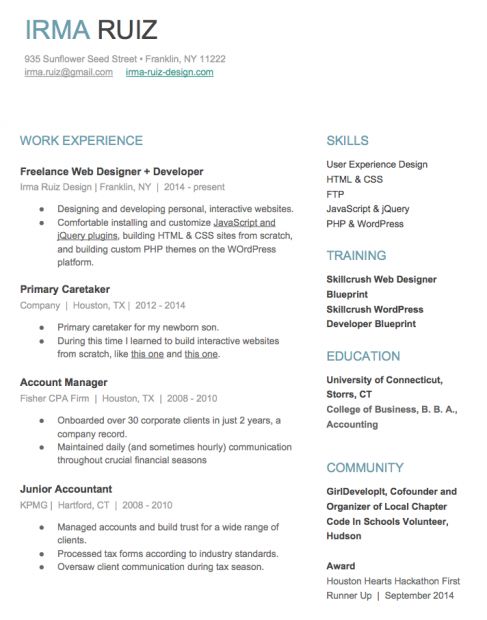
Did you breathe an audible sigh of relief? It’s not just easier on the eye to look at an airy resume like Irma’s—it also forces you to include only the most pertinent info.
(Get a detailed breakdown of Irma’s resume in The Ultimate Guide to the Perfect Resume to find out exactly how to turn your crowded resume into a minimalist hiring machine.)
2. You don’t need to include ALL your jobs
But wait. How do you decide what information to actually include? Reverse engineer it. Take a look at the job or freelance gig you want to get and ask yourself which parts of your history really qualify you for the job.
[Tweet ""Only include your most relevant jobs & projects on your resume." @randlebrowning"]
And don’t worry if this exercise leaves some gaps in your resume. One trick for dealing with those gaps is to switch from using months (Sept 2010–May 2011) to using years (2010–2011). Once you’re in an interview, you can talk through any in-between projects that come up.
3. Customize it
And that leads us to customization. As tempting as it is to create just one resume and stick to it for as long as possible, it’s really important to customize your resume for each job you apply for, or at least for each field/position.
There are a couple important reasons for that:
First, the only way to keep your resume minimalist is to cut it down to the most relevant information. And the most relevant information will vary widely based on the job you’re trying to land.
For example, if you want to get hired to redesign a website for a local musician, the 6 months you spent selling cake flags on Etsy might not help you get the gig. However, if you want to get hired to rebrand a bakery, you should definitely include it!
Second, the obvious. Hiring managers can usually tell if you’re sending out standardized application material, and if you really want the job? It’s worth it to put in some time to customize your resume.
[Tweet ""Do you really want the job? Customize your resume for each company." @randlebrowning"]
You can even make it easy on yourself by saving different versions of your resume. For example, maybe you have a video editing-focused resume that helps you get videography jobs, and a nonprofit-focused resume to help you land speaking jobs.
4. No one cares about your education

As someone who recalls the university library with warm fuzzies, I get it. It can be hard to let go of your educational conquests.
But in most cases, your education isn’t the MOST important quality that will make you great at a job. In the creative field, your work is what gets you hired, not your pedigree.
Sure, if you went to SCAD for illustration and want to get hired as a calligrapher, it makes sense to emphasize your education. But if you majored in poli sci before getting into web design, your 4 years in school aren’t going to qualify you for the job.
To place the emphasis on your work history instead of your education, reorder your resume so that your experience is more prominent, and delete outdated credentials like your GPA and other academic achievements.
[Tweet ""Place more emphasis on your work history instead of education on your resume." @randlebrowning"]
5. Broaden your definition of “work experience”
Maybe you’re looking at a history of freelance work (and those Etsy shops!) and wondering what actually qualifies as a job.
You don’t need to limit yourself to including typical “jobby jobs” with regular working hours and coworkers. One great trick is to compile all your work in a certain area under one item of work experience. For example, maybe you write “Copywriter + Content Marketer” as an item of work history, and then list some of your freelance projects in that area in the description.
6. Make it interactive
Speaking of freelance projects, make sure that you link to projects throughout your resume.
In the header of your resume, you’ll want to include links to any portfolios or personal websites, but you can also make your resume interactive by linking to projects throughout.
For example, when you describe your freelance work in the Copywriter + Content Marketer example above, link to some of your actual projects.
Linking to your work is important because it’s unlikely that a hiring manager or client will take the trouble to Google you and find your work. Make it easy for them and link to your most relevant work right in your resume.
7. Include numbers
It can seem a little odd to include metrics and data in a creative resume, but it’s actually really powerful (and totally possible, even if you don’t consider yourself a numbers person).
For example, rather than saying that you “ran the content marketing department” at a nonprofit you worked at, try something like, “I grew the newsletter subscriber list from 250 to 8,000 in 2 months.”
[Tweet ""Be specific and include numbers & statistics on your resume." @randlebrowning"]
Providing numbers gives clients and hiring managers solid data to lock onto to gauge how successful you’ll be in the job you’re applying for.
8. With skills, less is more
It can be easy to bulk up your resume with every skill set you can claim, from classics like Photoshop to dinosaurs like Microsoft Word and typing speeds. But out of date credentials that everyone is expected to have these days aren’t relevant.
Instead, focus on just the few in-demand skills that will be necessary in the job you’re applying for or the freelance gig you’re hoping to snag.
Besides, listing everything you’re remotely competent in can take the focus away from the areas where you really shine.
(And if you could use some updated chops, find out what digital skills you can learn in a Skillcrush Blueprint.)
9. Word choice matters

When writing or editing my resume, I tend to catch myself falling into “corporate speak.” You know what I’m talking about: terms like “team-player,” “goal-oriented,” and “hardworking.” What do those really mean?
Instead of tired descriptors that don’t really show who you are, use the tips above—like linking to portfolio projects and using numbers to track your success—to explain what you bring the table.
10. Make it pretty
3 cheers! You can unleash some of your creative energy into turning a lifeless business document into something beautiful and pleasant to read. But that doesn’t mean you can go nuts.
Add personality to the layout and header, but make sure that your resume is easy to read. That means a white background and either black or grey text (in a readable font), with just one color or a few shades to bring life to your header and links.
11. Community matters
When you’re looking for a job, it’s not just your qualifications that count. Most employers and clients also want to know that you’ll be a good fit in terms of personality. A great way to show that personality is to include 1 or 2 personal or community activities that are related to the field you’re looking for work in.
[Tweet ""Qualifications count, but your personality is crucial to communicate on your resume." @randlebrowning"]
For example, if you want to build a WordPress website for a client, listing your work as president of the local chapter of a WordPress Meetup is a great way to show that you really are a WordPress expert and you know what you’re talking about.
Sharing volunteer work and other ways you get involved in your the community also show that you’re not all talk—you’re truly passionate and dedicated to the work you want to get hired to do.
12. The best resumes tell a story
This one can sound cheesy, but it’s really important. If you look back at Irma’s resumes, the first one shows lots of STUFF, but it doesn’t tell you where Irma is coming from or where she wants to go.
Run your resume by a friend and ask her if it’s obvious how your past work feeds into what you do now, and if it’s obvious what kind of work you’re looking for.
The bottom line? With these resume tips in mind, it should be EASY for a hiring manager or client to imagine you doing the job they need you to do. That means including work experience that is directly related to the role you want, emphasizing your most important skill sets, and designing the document so that it’s easy to skim.
As a creative, you might find it tough to fit your history onto one slip of paper, but you’ve also got the skills to shape your resume so it depicts you in the best light.
And if all of these updates seem overwhelming, don’t worry. In The Ultimate Guide to the Perfect Resume ebook, you’ll get a simple blueprint for revamping your resume to get the job, complete with a quick-guide for updating your resume in just 15 minutes.
